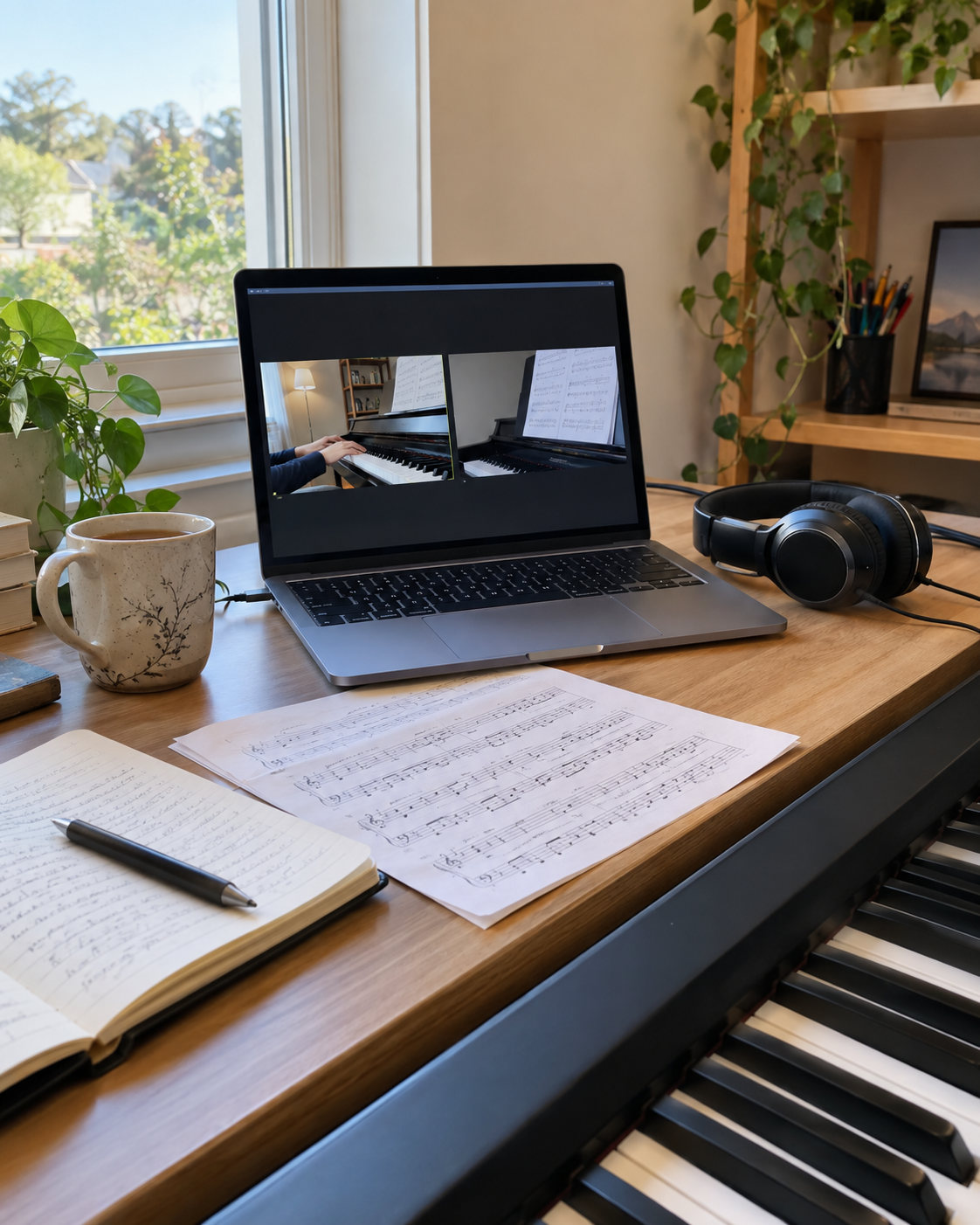
Work with your teacher from your own practice space. The lesson connects what you practised, what needs attention today and what you’ll work on next.
Lesson Materials
A lesson recording in Google Drive, a transcript by email and specific assignments for daily check-ins and longer practice. You can return to a demonstration or phrase when you practise, then bring that work back to your teacher.
New repertoire includes the original recording, a Stem4rge accompaniment track and an isolated vocal track. These are materials to listen to, learn from and sing with.
The structure varies with the student’s level and current work. A singing lesson begins with a brief check-in and a question about the voice or music. We review the progress worksheet and the practice before choosing the day’s exercise work.
Vocal Exercises
Guided warm-ups lead into listening and imitation or further coordination exercises. The teacher uses demonstrations, images and physical cues while the student works through exercises and phrases.
Repertoire Coaching
The student sings the complete song with an accompaniment track while the teacher listens and makes notes. We then try a broader adjustment or return to individual phrases.
Practice Assignments
The lesson ends with specific practice and asynchronous assignments. Upcoming performances and career-coaching deliverables are part of the check-in when they apply.
As students advance, they also sing and play patterns or melodies, or work on accompanying themselves.
Instruments and Theory
Instrument and theory lessons begin with patterned exercises and a review of written homework. We then work on the music the student is preparing.
Patterned Exercises
The student begins with the exercises assigned for their instrument and level.
Homework Review
Written homework gives the teacher and student something specific to examine together before moving into the piece.
Repertoire Study
In piano study, the work includes finger skills, reading a score and interpreting the piece.
A session may focus on lyrics, theory or composition. In lyric and composition work, we study the output and assignments from the previous week, then use exercises to develop the next version.
Lyrics
The writer works on lyric exercises and brings the previous week’s writing into the session for review.
Composition
We develop the music through exercises and work on the piece itself, with the output goal guiding the session.
Tracks and Arrangement
In advanced sessions, the teacher guides the songwriter on their own computer while they build tracks, arrange, orchestrate and develop the piece.
Playback makes it possible to isolate a voice or sound and examine it within the arrangement.
Equipment Requirements
For virtual lessons, you’ll need a PC or Mac with speakers, a webcam and a microphone. A phone or iPad does not meet the setup requirement.
Advanced Equipment
For advanced lessons and Vocal Integration, we recommend an audio interface, an external microphone, speakers, headphones and a keyboard or digital piano connected to your computer through MIDI or USB.
Lesson Software
You’ll receive the lesson software, including MIDIculous, a metronome and a digital audio workstation for recording and working with music tracks.
Accompaniment Tracks
The piano supports exercises and short phrases. For the complete song, the track accompanies the student so the teacher can concentrate on listening and taking notes.
Lesson Formats
Compare the equipment, schedule, learning style and musical focus of virtual and in-person lessons.